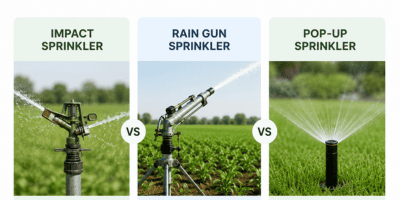
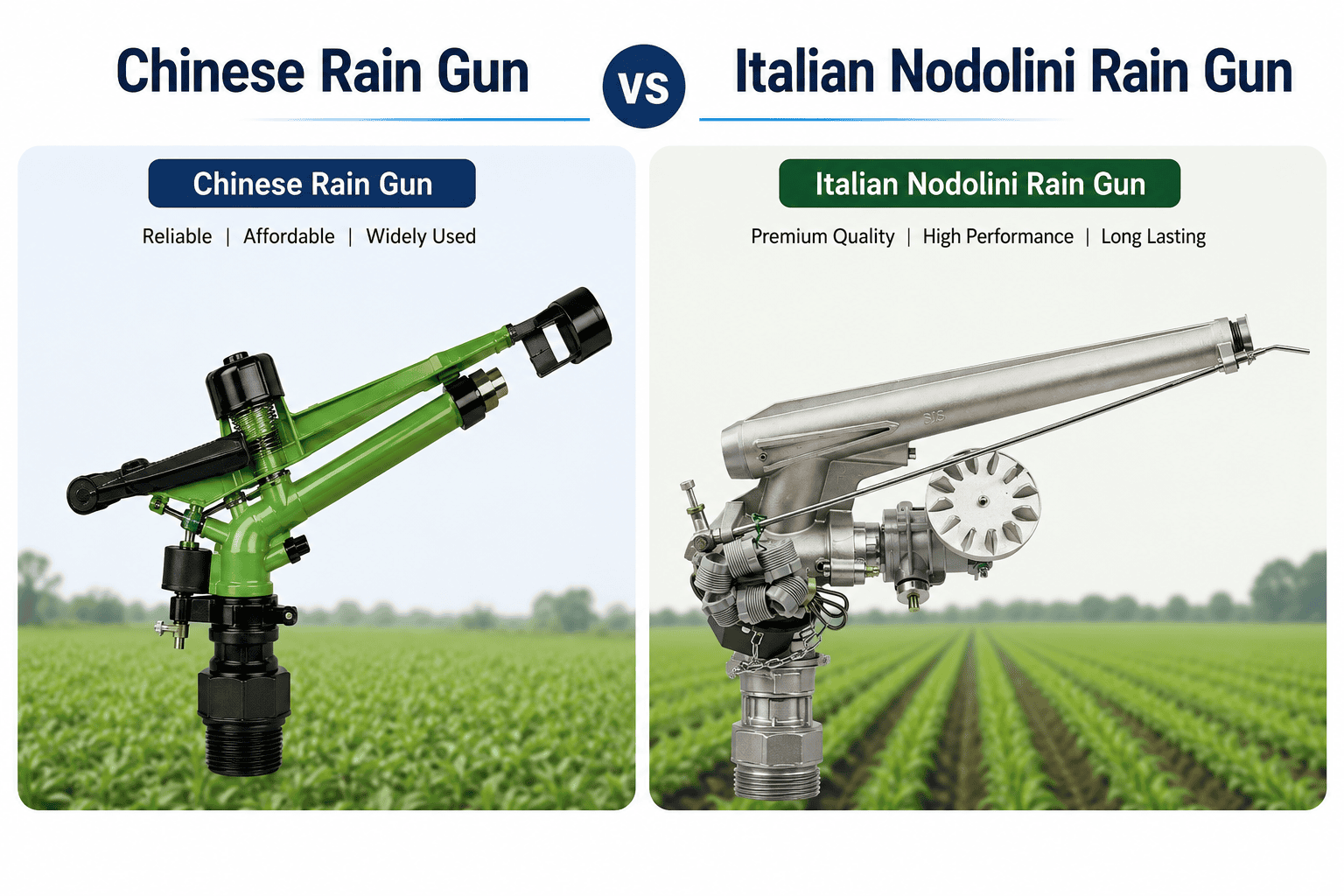
If you are planning to buy a rain gun for your farm, you have probably come across two common options: a 2-inch rain gun imported from China (usually advertised with a 100ft / ~30m throw radius) and the Italian-made Nodolini rain gun (like the S45 or S60, 2″ models). Both look similar from a distance — a big metal “gun” on a stand that shoots water in a circle — but under the hood, they are quite different in build quality, performance, and long-term value.This guide breaks down the real differences between the Chinese rain gun and the Nodolini rain gun in simple words so you can decide which one is right for your field.
1. Chinese Rain Gun vs Nodolini Rain Gun: Quick Side-by-Side Comparison
| Feature | Chinese 2″ Rain Gun | Italian Nodolini Rain Gun 2″( S45/S60) |
|---|---|---|
| Visual Reference | 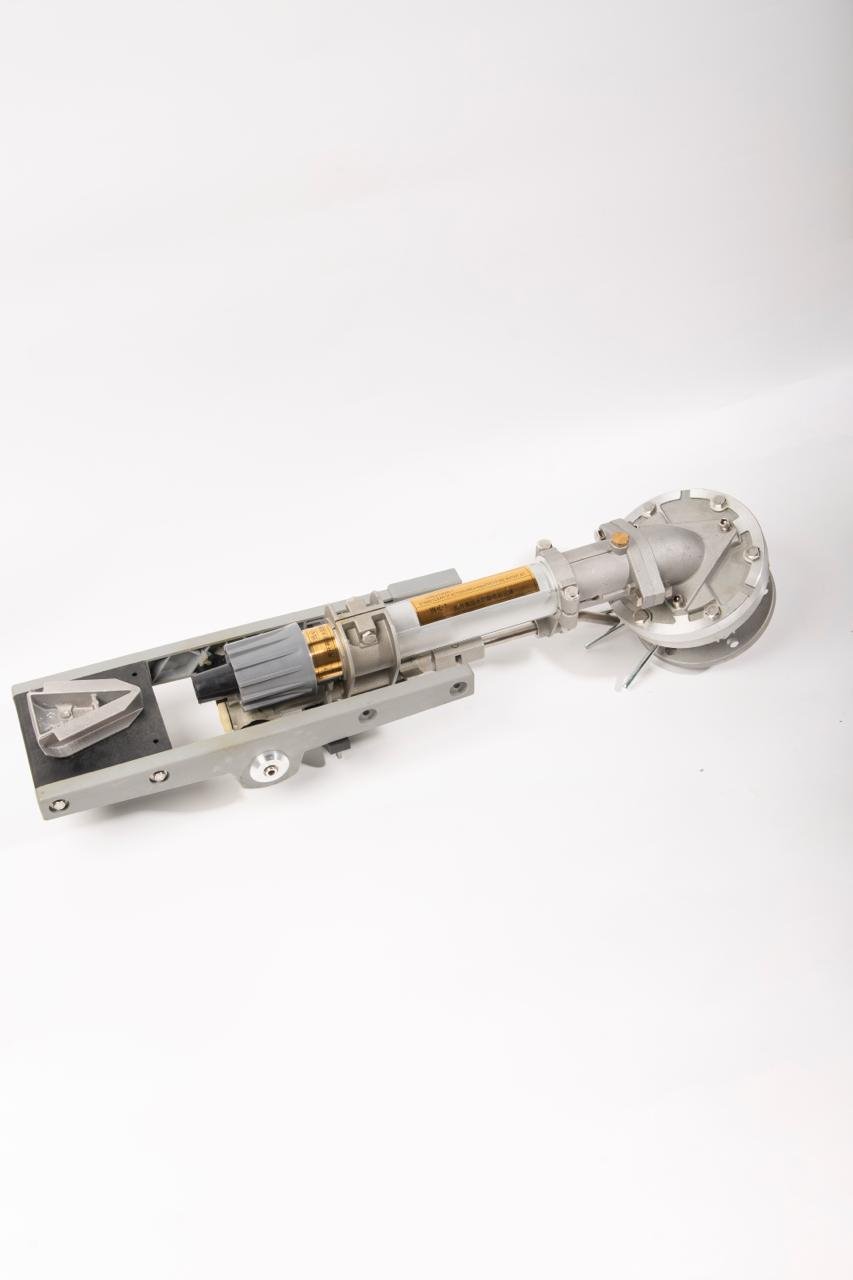 | 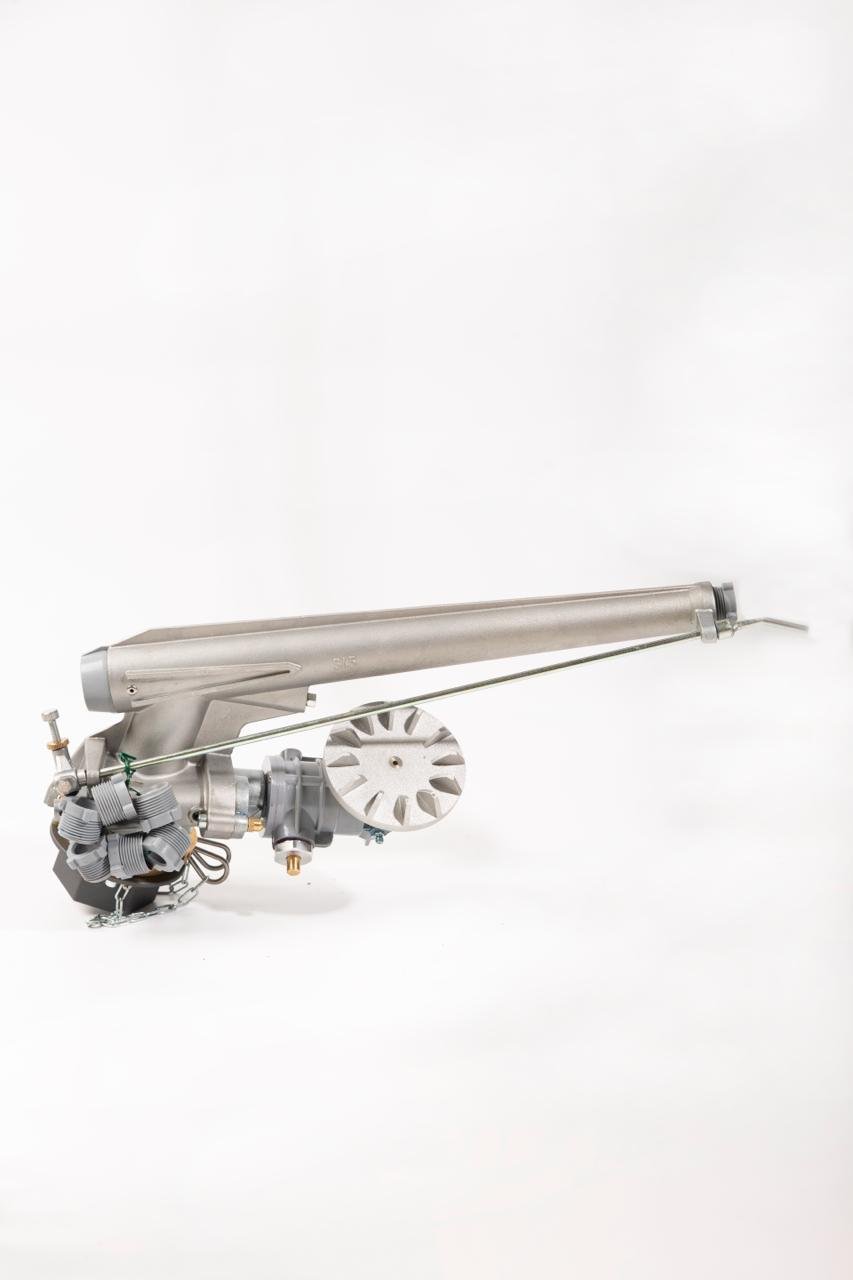 |
| Country of Origin | China (mass-produced by various factories) | Italy (Nodolini s.n.c., established 50+ years, specialist manufacturer) |
| Body Material | Usually aluminum body with a brass thread and includes other plastic parts such as nozzles; some budget models use more plastic parts. | Body and gear drive parts made from aluminum components treated with anodic oxidation, plastic coating and cataphoresis — among the highest quality materials used in rain guns. |
| Drive Mechanism | Mostly spring-arm impact drive (the “clicking arm” type); some gear/turbine models also available. | Geared turbine drive — smoother, more controlled rotation, no hammering impact on the nozzle. |
| Throw Radius (2″ size) | Around 100ft (about 30 meters), though actual reach depends heavily on pump pressure and nozzle size. | Higher-end throw — the S60 2″ Long Throw model reaches up to 57m / 186ft radius, with dust suppression versions covering a similar range depending on nozzle size. |
| Nozzle Options | Usually comes with 2 nozzle sizes. | Comes with multiple interchangeable nozzles (18mm, 20mm, 22mm, and 24mm on the S45), letting you fine-tune radius and flow to your crop needs. |
| Water Uniformity | Can be uneven — water often falls heavier near the sprinkler and thinner at the edges, especially at lower pressure. | Designed with very high-pressure uniformity, offering close to perfect water coverage from near the gun to the end, thanks to precision-engineered nozzles and steady gear turbine rotation. |
| Build Durability | Decent for short-to-medium term use; bearings and seals may wear faster under continuous heavy use. | Built to last long-term, extremely reliable and durable while consuming the least amount of water compared to Chinese counterparts, with corrosion-resistant materials. |
| Noise Level | Loud, sharp clicking/hammering sound (typical of impact-drive design). | Smoother, quieter rotation due to gear-turbine design. |
| Vibration on Stand | Higher — the impact-style hammering arm can shake the stand or tripod over time. | Lower — turbine drive rotates smoothly, reducing wear on the tripod and hose connections. |
| Pressure Requirements | Typically works in a wide but variable range; performance drops noticeably if pressure is low. | Engineered to perform consistently across its rated pressure range, even at low pressure — giving a more predictable result. |
| Consistency across Units | Can vary batch to batch or company to company since many different factories produce similar-looking models. | Very consistent — comes from one specialized factory in Italy with decades of continuous R&D, development and testing. |
| Price | More budget-friendly, often 30% or more less than the Italian gun. | Significantly more expensive, reflecting premium materials and engineering. |
| Spare Parts Availability | Often limited or inconsistent, especially for cheaper unbranded models. | Established distributor network with genuine spare parts and dedicated support. |
| Best Suited For | Small to medium farms, budget-conscious buyers, short-term or seasonal use. | Larger farms, orchards, dust suppression, and users who want a long-term investment with consistent performance. |
2. Material Quality — What’s Really Inside Each Rain Gun?
Chinese 2″ rain guns are usually built from a mix of aluminum casting and brass or engineered plastic parts. This keeps the price low, and the sprinkler still works well for basic watering needs. However, cheaper plastic components (like internal gears or nozzle threads) can wear out faster, especially if the rain gun runs for many hours every day during peak season.Nodolini rain guns, on the other hand, are built with a focus on longevity. Nodolini manufactures its rain guns from the highest quality materials, with all gears made of metal — not plastic. This means the internal moving parts (gears, bearings, seals) are designed to handle years of continuous, heavy-duty use without breaking down. The company has also built specific engineered surface protection systems for use with corrosive water sources, something budget models rarely offer.In simple terms: The Chinese rain gun is good “value for money” for basic jobs, while the Nodolini is built like a long-term farm tool meant to survive decades of heavy field use.
3. Throw Distance — How Far Does the Water Actually Go?
The “100ft radius” advertised on Chinese 2″ rain guns is often the maximum possible distance under ideal pressure conditions — meaning you need a strong pump and the largest nozzle to hit that number. In real farm conditions with average pressure, the effective radius is often noticeably less.Nodolini rain guns are rated more conservatively and consistently. For example, the S60 2″ Long Throw model is rated for up to 57 meters (about 187 feet) throw radius, and the S45/S60 dust suppression versions cover up to 57 meters (about 187 feet) depending on which nozzle is fitted. Nodolini gives you a range of interchangeable nozzles, so you can pick the exact nozzle size that matches your available water pressure and get a throw distance you can count on — not just a number on the box.In simple terms: The Chinese rain gun’s “100ft” is a best-case number, while Nodolini gives you real, adjustable throw distances backed by tested performance data.
4. Water Uniformity — Is the Water Spread Evenly?
This is one of the biggest practical differences between the two.- Chinese rain guns often throw water unevenly across their circle — you may notice more water landing close to the sprinkler and less at the far edge, creating “wet” and “dry” rings in your field. This happens because of simpler nozzle design and less precise manufacturing tolerances.
- Nodolini rain guns are specifically engineered for this problem. The company advertises very high-pressure uniformity that offers perfect water coverage, ideal for agricultural and commercial use. The water is spread evenly, which means your crops at the edge of the circle get almost as much water as the crops near the center — better for overall yield and water efficiency.
In simple terms: If even watering across your whole field matters to you (which it does for most crops), Nodolini has a real, measurable edge here compared to other competitors.
5. Durability and Long-Term Reliability
Nodolini has been making rain guns for over 50 years, focusing only on this product category. This kind of specialization tends to show up in small design details — better bearing seals, smoother rotation, and materials chosen specifically to resist rust and corrosion over years of outdoor use, reflected in the company’s emphasis on durable construction with corrosion-resistant materials and its weatherproof design that performs effectively in various weather conditions.Chinese 2″ rain guns can absolutely get the job done, especially for smaller operations or seasonal use, but many budget models are designed to be replaced every few seasons rather than repaired and reused for a decade or more.6. Cost vs Value — Which One Makes Sense for You?
| Your Situation | Better Choice |
|---|---|
| Small or medium farm, tight budget, seasonal use | Chinese 2″ Rain Gun |
| Large farm, orchard, or commercial operation needing consistent yield | Nodolini Rain Gun |
| Dust suppression or industrial water spraying | Nodolini Rain Gun |
| Need for very high daily working hours over many years | Nodolini Rain Gun |
| Testing irrigation setup before a bigger investment | Chinese 2″ Rain Gun |
Frequently Asked Questions
Is a Chinese rain gun as good as a Nodolini rain gun?
A Chinese 2″ rain gun is a good budget option for basic irrigation on small to medium farms, but it generally can’t match the water uniformity, metal-gear durability, or consistent throw distance of an Italian Nodolini rain gun, which is built for long-term, heavy-duty use.
How much farther does a Nodolini rain gun throw water compared to a Chinese rain gun?
A typical Chinese 2″ rain gun is rated around 100ft (about 30 meters), while the Nodolini S60 2″ Long Throw model can reach up to 57 meters (about 187 feet) — nearly double the range, depending on nozzle size and water pressure.
Which rain gun gives more uniform water coverage?
Nodolini rain guns are specifically engineered for high water uniformity, spreading water evenly from the center to the edge of the circle. Chinese rain guns can be uneven, especially at lower pressure, leading to wetter and drier rings in the field.
Is the Nodolini rain gun worth the higher price?
For larger farms, orchards, or dust suppression use where consistent yield and long-term reliability matter, the Nodolini rain gun’s higher upfront cost is often offset by lower replacement costs and better water efficiency over time. For small budget-conscious or seasonal use, a Chinese rain gun may be the more practical choice.
Final Takeaway
- Choose the Chinese 2″ rain gun if you want an affordable option for a smaller farm or you’re just getting started with rain gun irrigation.
- Choose the Italian Nodolini rain gun if you run a larger operation, care about even water distribution across your whole field, and want equipment built to last for many years without replacement.
Need Help Choosing the Right Irrigation System?
For more detailed or personalized advice on choosing the perfect Rain Gun setup for your home or agricultural farm, contact our engineering support team directly:- Website: okelectricalind.com
- WhatsApp Support: +92 300-4282378 or +92 321-4888188