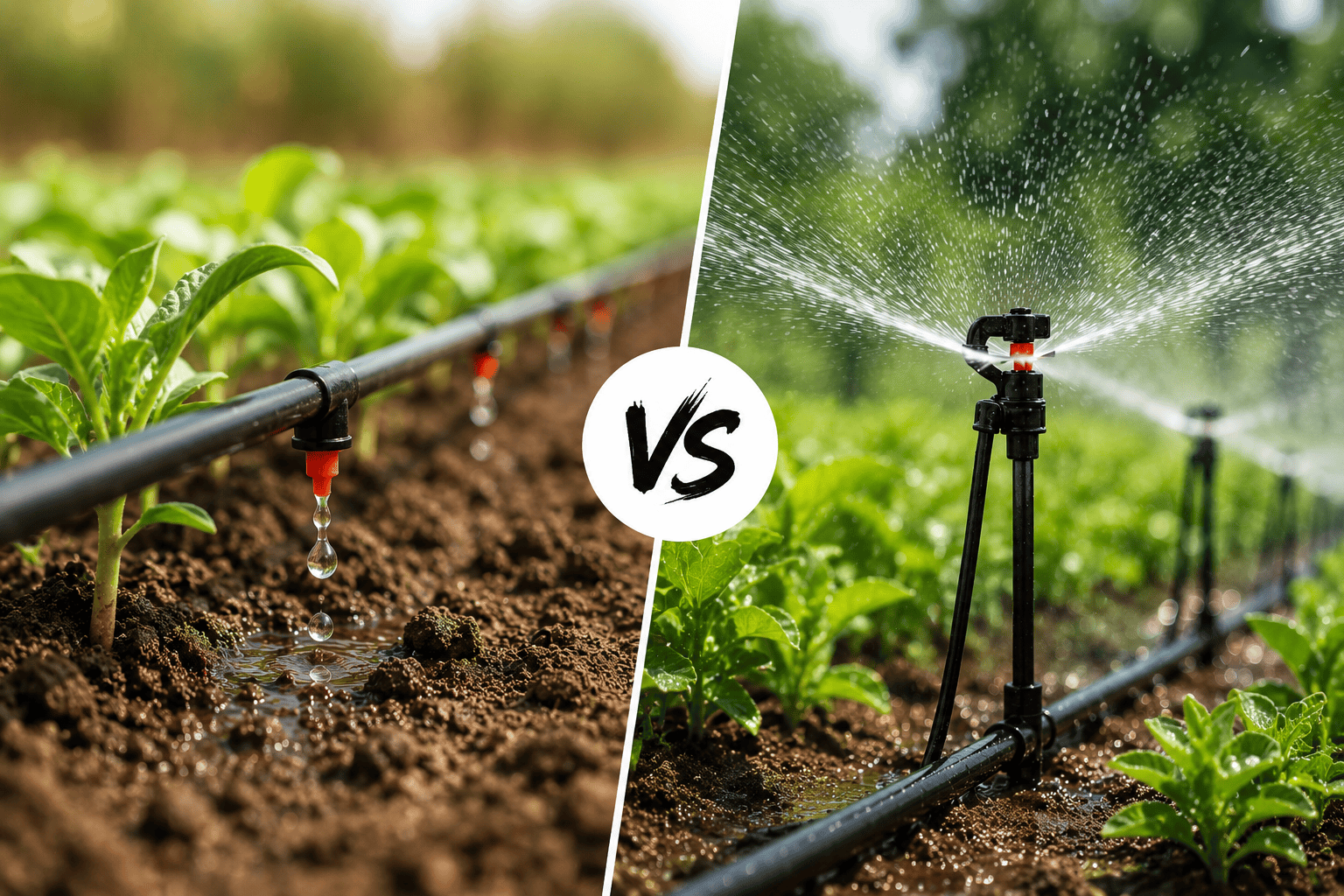
Drip irrigation is one of the smartest ways to water your farm, orchard, or garden. Instead of spraying water everywhere, it sends water straight to the plant’s roots — which means less waste and healthier crops. But once you start shopping for a drip irrigation system, you will run into two main types of watering devices: drip irrigation nozzles (also called drippers or emitters) and micro sprinklers (also called micro sprayers).
In this guide, we explain what drip irrigation is, break down the different types of drip nozzles and micro sprinklers, compare their materials and specifications side by side, and help you understand which one fits your needs best.
What Is Drip Irrigation?
Drip irrigation is a watering method that delivers water slowly, drop by drop, directly to the root zone of a plant through a network of pipes, tubing, and small water outlets called emitters or nozzles. Because the water goes right where the plant needs it, drip irrigation uses much less water than traditional flood or sprinkler methods, and it also helps reduce weed growth since the areas between plants stay dry.
A typical drip irrigation setup includes a main water line, smaller lateral pipes or tubing running along the crop rows, and drip nozzles or micro sprinklers attached at set spacing to release water exactly where it’s needed.
Types of Drip Irrigation Nozzles (Emitters)
Drip nozzles, also called drippers or emitters, are small devices that release water slowly and steadily. There are a few main types:
1. Inline Drip Emitters
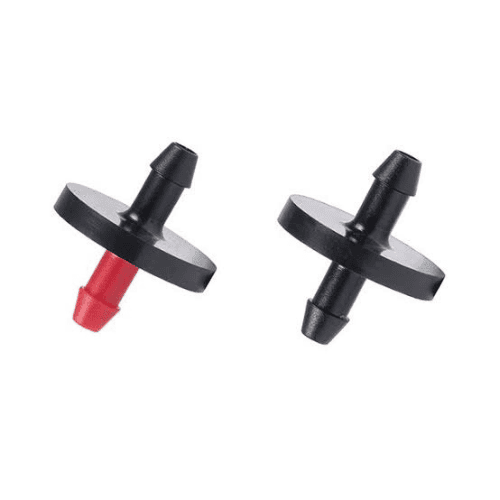
These emitters are built into the drip tubing itself at set spacing, so the tubing and the emitters come as one piece. They are simple to install and work great for row crops like vegetables, where every plant needs the same steady amount of water.
2. Online (Button) Drip Emitters
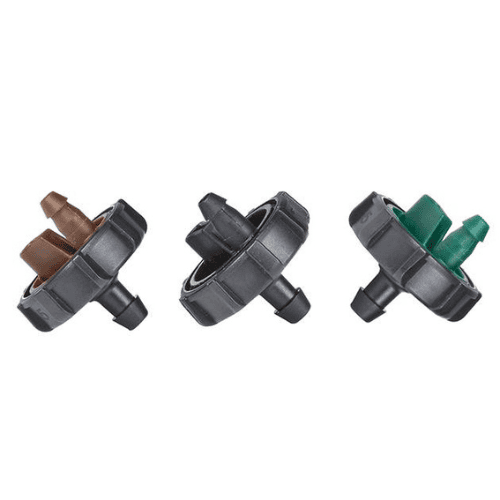
These are separate small nozzles that you punch into the tubing wherever you want. This gives you the freedom to place water exactly where each plant is, which makes online emitters ideal for trees, shrubs, and unevenly spaced plants.
3. Pressure-Compensating (PC) Emitters
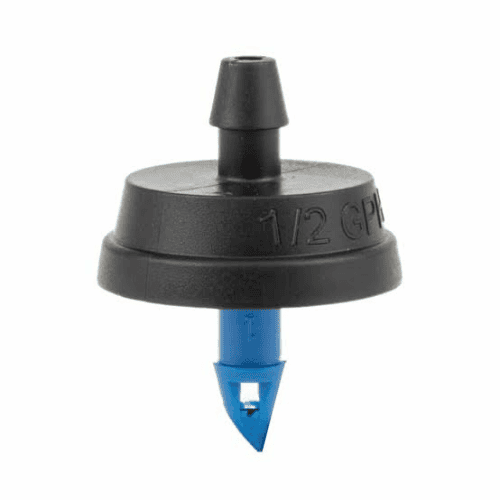
PC emitters have a flexible diaphragm inside that automatically adjusts to keep the flow rate the same, even if water pressure changes across a long row or a sloped field. This means every plant gets the same amount of water, whether it’s at the start or the end of the line.
4. Non-Pressure-Compensating (Non-PC) Emitters
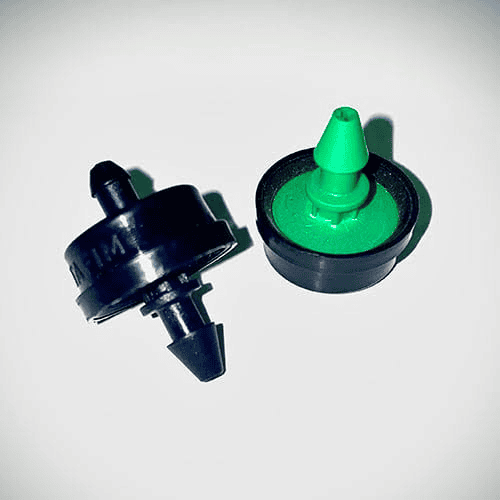
These are simpler and cheaper, but the flow rate changes depending on the water pressure at that point in the line. They work fine on flat land with steady pressure but are not ideal for slopes or very long rows.
What Are Micro Sprinklers?
Micro sprinklers (also called micro sprayers or mini sprinklers) are small spinning or spraying heads that release a fine mist or light spray of water over a wider area than a drip nozzle. Instead of watering one exact spot, a micro sprinkler wets a circle of soil around it — useful for young trees, nursery beds, and greenhouse crops that need both root watering and a bit of humidity in the air around them.
Micro sprinklers usually sit on a small stake above the ground and connect to the drip tubing through a thin feeder tube, making them easy to move or adjust as plants grow.
Drip Nozzles vs Micro Sprinklers: Side-by-Side Comparison
Here is an easy comparison table showing the material and specification differences between drip irrigation nozzles and micro sprinklers.
| Feature | Drip Nozzle / Emitter (Dripper) | Micro Sprinkler (Micro Sprayer) |
|---|---|---|
| What it does | Releases water drop by drop, directly at the base of one plant | Sprays a fine mist or small jet of water over a wider area |
| Body material | PP (polypropylene) or ABS plastic body; silicone or rubber diaphragm inside PC types | PP or ABS plastic body and spinner/deflector; some have a PVC or metal stake |
| Common flow rate | 0.5 – 16 L/H (liters per hour) for most garden and farm nozzles | 20 – 300 L/H, much higher than a drip nozzle |
| Coverage area / wetted diameter | A small, focused wet circle right at the emitter (a few inches to about 1 foot) | A wider circle, typically 6–33 feet (2–10 meters) diameter depending on model |
| Water pressure needed | Low, usually 0.5–2 bar (7–30 PSI) | Low to medium, usually 1–2.5 bar (15–35 PSI) |
| Pressure compensating (PC) option | Available — keeps flow steady on slopes and long rows | Available on some models — keeps spray radius steady across uneven land |
| Best for | Vegetable rows, potted plants, flower beds, individual trees and shrubs | Orchards, nurseries, greenhouses, ground cover, and cooling/humidifying crops |
| Water loss to evaporation | Very low — water goes straight into the soil | Slightly higher — water travels through the air before landing |
| Clogging risk | Higher in dirty water since openings are very small; needs a good filter | Lower than drip nozzles, but still needs a filter to stay clog-free |
| Cost per unit | Low — among the cheapest irrigation components available | Slightly higher than a basic drip nozzle, but still budget-friendly |
Material Quality: What Are They Made Of?
Both drip nozzles and micro sprinklers are almost always made from plastic, but the exact type of plastic affects how long they last and how well they resist damage from sunlight, fertilizer, and water pressure.
- Drip nozzles/emitters are usually made from PP (polypropylene) or ABS plastic for the outer body, since these plastics resist cracking and chemical damage from fertilizers. Pressure-compensating emitters also include a soft silicone or rubber diaphragm inside, which flexes to control the flow rate.
- Micro sprinklers use a similar PP or ABS plastic body, with a spinning or deflecting part on top (often ABS or POM plastic, chosen for smooth, low-friction rotation) that breaks the water stream into a fine spray. Some models also come with a PVC or metal stake for support.
Both types are generally UV-stabilized, so they don’t turn brittle from long-term sun exposure, but cheaper unbranded models sometimes skip this treatment, causing the plastic to crack faster after a season or two in strong sunlight.
Advantages of Drip Irrigation Nozzles
- Very low water use — water goes straight to the roots with almost no evaporation loss.
- Precise watering — each plant gets exactly the amount of water it needs.
- Keeps leaves dry — reduces the risk of fungal disease since water doesn’t touch the leaves.
- Low pressure needed — works well even with smaller pumps or gravity-fed tanks.
- Affordable — among the cheapest irrigation components you can buy.
Advantages of Micro Sprinklers
- Wider coverage — one micro sprinkler can water a bigger area than a single drip nozzle.
- Good for young trees and nurseries — wets a circle of soil around the trunk instead of just one point.
- Adds humidity — helpful for crops that benefit from light air moisture, especially in greenhouses.
- Fewer clogging issues — the spray openings are generally a bit larger than drip nozzle openings.
- Flexible placement — easy to raise, lower, or move as your plants grow.
Which One Should You Choose?
- Vegetable rows or potted plants — go with drip nozzles for precise, low-waste watering.
- Young trees, nurseries, or greenhouse crops — micro sprinklers give wider coverage and a bit of helpful humidity.
- Sloped or uneven land — choose pressure-compensating (PC) versions of either type for even watering.
- Dirty or sediment-heavy water source — micro sprinklers clog less often than fine drip nozzles, but a good filter helps either way.
Many farms use both together — drip nozzles along vegetable rows and micro sprinklers under fruit trees — to get the best of both worlds.
Frequently Asked Questions About Drip Nozzles and Micro Sprinklers
Need Help Choosing the Right Equipment to Buy?
For more details or personalized assistance in choosing the ideal submersible pump, fountain lights, fountain nozzles, fountain systems, drip systems, or sprinkler systems for your home or farm, get in touch with us:
- Visit our website: okelectricalind.com
- Contact us on WhatsApp: +92 300-4282378 or +92 321-4888188